
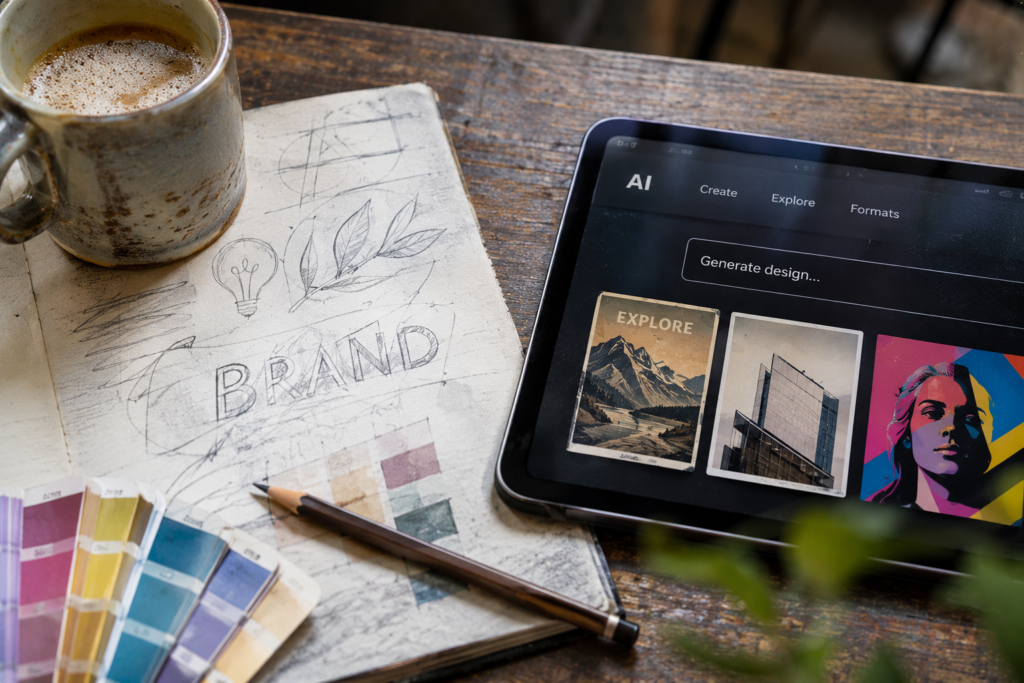
AI can produce in seconds what once took a designer hours. But as technology becomes increasingly capable of creating almost anything, are we overlooking something important about why humans create in the first place?
There was a time when producing professional graphic design required years of learning, practice and patience.
You needed to understand typography, colour, composition and the countless small decisions that separate a memorable design from a forgettable one.
Today, you can type a few sentences into an AI image generator and produce something remarkable in seconds.
It’s impressive. It’s exciting.
And for someone who has spent years developing those skills, it must also be unsettling.
If a machine can do in thirty seconds what took me thirty years to learn, where does that leave me?
The anxiety is real
It’s easy to dismiss these concerns by saying AI is simply another tool.
But there’s an important difference. Previous technologies generally helped designers produce creative work. Generative AI can now produce much of the visible work itself.
Imagine spending years studying illustration, only to discover that a potential client can generate twenty concepts before you’ve finished reading the brief.
Or entering the industry as a junior designer, competing with software that can produce polished artwork almost instantly.
These aren’t imaginary concerns. They affect people’s careers, incomes and confidence in their futures.
And there’s nothing contradictory about appreciating what AI can do while worrying about what it might replace.
AI is genuinely good at design
We shouldn’t pretend otherwise.
AI can produce impressive illustrations, advertising concepts, product imagery and branding ideas. It can also remove backgrounds, generate variations and speed up repetitive production tasks.
For small businesses with limited budgets, that accessibility is valuable.
But there’s a consequence.
When something becomes easier to produce, people may expect more of it, more quickly and for less money.
Work that once required hours of professional attention can begin to look like something that should cost almost nothing.
The question isn’t whether AI makes design faster. It’s whether faster production necessarily means better creativity.
A beautiful image isn’t always a meaningful one
Think about an album cover, film poster or illustration that has stayed with you.
What makes it memorable?
Perhaps it’s the colours or composition. But often there’s something deeper: a memory, an emotion or a connection to a particular moment in your life.
Design becomes part of our experiences.
Human designers bring their own experiences into their work, too. Their influences might come from childhood, music, conversations, relationships or something they noticed while walking home.
Sometimes those influences are deliberate. Sometimes they’re completely unexpected.
AI-generated work can certainly be meaningful to the people viewing it. But the human creative process has a significance of its own.
Creativity isn’t always just about what we produce. It’s also about what we bring to the process.
Personality may become more valuable
There’s something curious about AI-generated imagery.
Individually, the results can be extraordinary. Yet when we see hundreds of similarly polished images, they can begin to feel strangely familiar.
Perfect lighting. Balanced compositions. Flawless textures.
Everything looks impressive, but not everything feels distinctive.
Perhaps that’s where personality becomes increasingly important.
Consider a small independent café. Its visual identity could be perfectly polished, or it could feature unconventional typography and illustrations inspired by the owners’ experiences and neighbourhood.
Neither approach is automatically better.
But the second has an opportunity to communicate something personal.
And that connection can be more memorable than technical perfection.
Creativity is also a conversation
Good graphic design isn’t simply about arranging shapes and colours.
It’s about understanding people.
A designer listens, asks questions and sometimes recognises that what a client requests isn’t quite what they need.
A business owner might ask for a modern logo when what they’re really trying to communicate is trust.
These discoveries often emerge through conversation, collaboration and shared experience.
AI can help analyse briefs and suggest ideas, but human collaboration offers something different: disagreement, unexpected inspiration and the satisfaction of creating something together.
The relationship can be as valuable as the finished design.
Let’s not romanticise the past
Not every design project is a masterpiece.
Graphic design has always involved repetitive work, commercial pressures and tight deadlines.
And not every small business can afford a professional designer.
AI makes visual communication accessible to people who previously lacked the money, software or technical skills to participate.
That’s worth celebrating.
Someone with a good idea can now explore it visually without years of training.
The challenge is making creativity more accessible without forgetting the value of those who have dedicated their careers to it.
Could AI actually make designers more creative?
There’s an optimistic possibility here.
What if designers spent less time resizing images, preparing variations and carrying out routine edits?
What if they had more time to research, experiment, collaborate and develop stronger ideas?
AI could become an extraordinarily useful creative assistant.
But technical knowledge and creative judgement still matter.
Generating a logo isn’t the same as understanding branding. Producing an attractive composition doesn’t necessarily mean understanding why it works.
And when you can generate almost anything, knowing what not to create may become one of the most valuable skills of all.
What about the next generation?
This is one of the more difficult questions.
Designers traditionally develop through practice, mistakes and experimentation.
They produce work that isn’t particularly good, and gradually learn how to make it better.
But what happens when AI can immediately produce something more polished than a beginner?
Will aspiring designers still learn the fundamentals? Will employers continue offering junior designers opportunities to develop?
AI could become an excellent learning companion. Equally, it could encourage people to skip the difficult stages of learning.
There’s a difference between understanding why something works and simply selecting an attractive result.
That distinction matters.
There’s still beauty in imperfection
Some of the most memorable creative work isn’t perfectly polished.
A rough pencil illustration. An unusual typeface. A photograph with unexpected lighting.
Sometimes imperfections give something its character.
AI can imitate those qualities, but there’s a difference between reproducing the appearance of an accident and experiencing the accident that inspires a new idea.
Human creativity often involves discovering something we weren’t looking for.
And that’s part of its beauty.
So, is graphic design dead?
No. But it’s changing, and the disruption shouldn’t be underestimated.
Some creative work will become less commercially viable. Some designers will face difficult adjustments. Others will discover entirely new opportunities.
The future probably isn’t simply humans versus machines.
Some people will use AI to create affordable designs. Others will seek out human designers for their experience, originality and collaborative approach. Many designers will combine both.
Perhaps the real opportunity is to reconsider what we value about creativity.
A machine can generate a thousand beautiful images.
A human can look at those images and decide that none of them says what needs to be said.
That judgement matters.
And as the world fills with increasingly polished, generated content, perhaps we’ll come to appreciate work that feels personal even more.
Because creativity isn’t defined entirely by the finished piece.
It’s also found in the curiosity that starts the process, the experiences that shape an idea and the satisfaction of bringing something into existence.
AI may change how we create. It may change who gets to create. But the human desire to express something, to be understood and to make something that matters isn’t going anywhere.
And perhaps, in a world full of perfectly generated images, the things we’ll value most are those that remind us there’s a person behind them.
Not because they’re perfect.
But because they’re human.
Want a hand putting this into practice?
Tell us what you are working on and we will come back with clear, honest advice and a fair quote. No pressure, no jargon.