
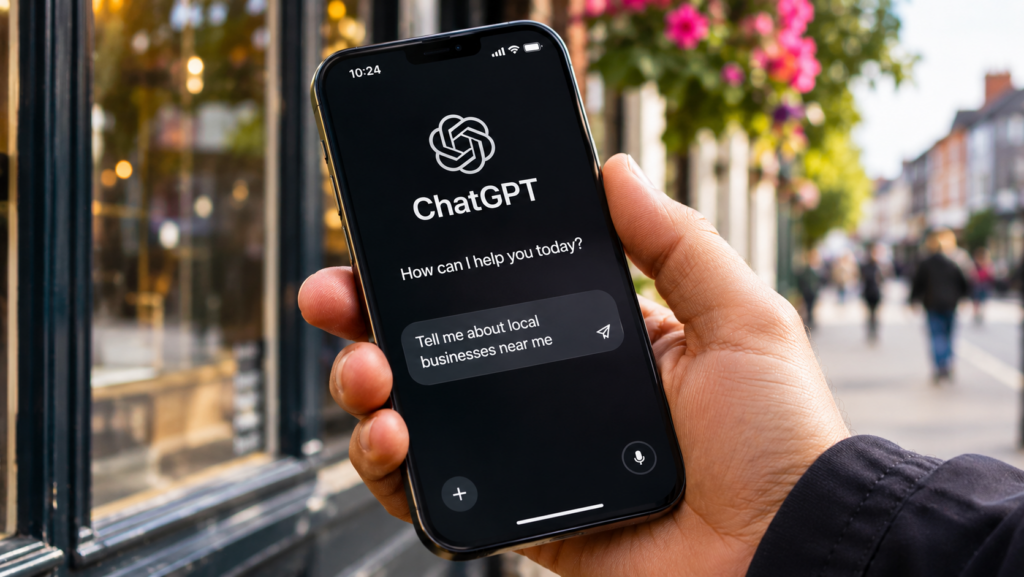
When someone wants to find out about a business, searching Google has become second nature. You look through the results, check a few reviews, visit the website and decide whether to get in touch.
But increasingly, people are asking AI assistants to do some of that research for them.
Instead of searching for several companies individually, someone might ask ChatGPT to recommend a local accountant, compare website hosting providers or find a suitable supplier.
That raises an interesting question.
What happens when ChatGPT gets the information about your business wrong?
Perhaps it mentions an old address, overlooks a service you offer or provides information that’s no longer accurate.
Until recently, businesses had limited ways to influence how their information appeared in AI-generated responses.
Now, OpenAI is taking steps to address that.
On 10 November 2026, OpenAI reportedly introduced a beta programme called Businesses in ChatGPT, giving eligible businesses the opportunity to claim and manage verified profiles.
It’s an interesting development, particularly for smaller businesses trying to understand how AI might influence the way customers discover them.
What is Businesses in ChatGPT?
The idea is fairly straightforward.
Much like claiming a Google Business Profile, eligible companies can verify their ownership and manage certain information about their business through a new Business Hub.
According to reporting on the announcement, the platform allows businesses to:
- Claim and verify their business profile.
- Review and correct business information.
- Add product information where supported.
- View aggregated data about business mentions within ChatGPT.
- See information about website traffic referred from ChatGPT.
That last point is particularly interesting.
Traditional website analytics can tell you when someone arrives at your website from a particular source. But understanding how often your business is discussed or recommended within an AI conversation is much more difficult.
Having greater visibility into that activity could help businesses understand how customers are discovering them.
However, the platform is still in beta, and the availability of individual features may vary.
How does verification work?
To claim a profile, businesses need to demonstrate that they genuinely own or represent the company.
Reported verification methods include:
- Business telephone number: Confirming ownership through a recognised company number.
- Business email address: Using an email associated with the business.
- Domain verification: Adding a DNS record to demonstrate control of the company’s website.
- Shopify verification: Connecting an eligible Shopify account.
These methods should be familiar to anyone who has previously verified a website or claimed an online business listing.
For businesses that don’t manage their own website or domain settings, some assistance from their hosting provider or website administrator may be necessary.
The important point is that verification is intended to establish legitimate ownership, rather than allowing anyone to edit a company’s information.
Is it free?
At launch, the Business Hub is reportedly available free of charge.
OpenAI hasn’t ruled out introducing paid features later, although the details of any future pricing remain unclear.
It’s also worth making an important distinction.
Verifying a business doesn’t mean ChatGPT will automatically recommend it more often.
According to reporting on the announcement, paying for business-related features does not influence how frequently ChatGPT recommends a company.
That distinction matters because businesses should be wary of claims that verification guarantees better AI search visibility.
A verified profile may help improve the accuracy of information, but it shouldn’t be confused with buying a prominent position in recommendations.
Why does this matter for small businesses?
Imagine someone looking for a local electrician.
Rather than searching through multiple websites, they ask ChatGPT to suggest a few suitable companies nearby.
The assistant might describe their services, explain the areas they cover and provide links to their websites.
Now imagine one of those companies has recently expanded into commercial electrical work, but ChatGPT only mentions domestic services.
A potential customer looking for commercial work might simply move on.
The business wouldn’t necessarily know that the opportunity existed.
This illustrates a broader issue with AI-assisted discovery.
It’s no longer just about whether your business can be found. It’s also about whether the information being presented is accurate.
Of course, ChatGPT isn’t the only way people discover businesses, and traditional search engines remain important.
But as more people experiment with AI assistants, businesses have another place where their reputation and information may be represented.
Is this the beginning of AI search optimisation?
You may have encountered terms such as Generative Engine Optimisation (GEO) or AI Search Optimisation.
Both broadly describe attempts to improve how information is discovered, interpreted and presented by AI-powered systems.
It’s an emerging field, and there’s considerable interest in how businesses might improve their visibility within AI-generated answers.
But it’s worth approaching the subject with a little caution.
AI systems don’t all retrieve, interpret or recommend information in the same way. Their behaviour can also change as the technology develops.
There’s currently no universal checklist that guarantees a business will appear in ChatGPT recommendations.
What we do know is that clear, accurate and accessible information remains valuable.
A business website should explain:
- What the company does.
- Which products or services it offers.
- Where it operates.
- Who its services are intended for.
- How customers can get in touch.
Keeping this information consistent across reputable online sources is sensible regardless of whether a customer finds you through Google, ChatGPT or another platform.
The fundamentals of communicating clearly haven’t changed simply because the technology has.
What about AI agents that speak to customers?
Another aspect of the announcement involves AI agents that can represent businesses and assist customers with certain tasks.
These are different from a verified business profile.
Rather than simply providing information about a company, an AI agent could help customers explore products, answer questions or move towards making a purchase.
For example, an online retailer might use an AI assistant to help someone compare products based on their requirements.
At launch, these business agent capabilities are reportedly limited to eligible e-commerce and online service businesses in the United States.
That means most UK small businesses won’t immediately have access to the full range of features.
Nevertheless, it gives us an indication of how online customer interactions could evolve.
The challenge will be making sure these systems are accurate, reliable and genuinely useful.
An AI assistant that confidently provides incorrect information isn’t particularly helpful, regardless of how sophisticated the technology behind it might be.
Should you claim your business profile?
For eligible businesses, there’s a reasonable argument for doing so.
If a platform is providing information about your company, having an opportunity to verify and correct that information is generally beneficial.
However, it’s worth understanding the limitations.
Claiming a profile doesn’t guarantee additional enquiries, increased traffic or more frequent recommendations.
And because the programme is still in beta, its capabilities and availability may change.
For now, a sensible approach would be to:
Check how your business is represented
Ask ChatGPT about your company and review the information it provides. Try several relevant questions rather than relying on one response.
Remember that AI-generated answers can vary and aren’t necessarily a complete picture of how frequently your business appears.
Review your website information
Make sure your contact details, services and business information are accurate and easy to find.
Check your existing online listings
Keep your Google Business Profile and other reputable listings up to date.
Make sure you can verify ownership
Know who manages your business email, domain and DNS settings so you’re prepared if verification becomes available.
Avoid unnecessary spending
There’s no reason to invest heavily in unfamiliar AI optimisation services simply because a new platform has launched.
Understand what the tools offer before deciding whether they’re useful for your business.
A wider change in how we discover information
Perhaps the most significant part of this announcement isn’t the verification process itself.
It’s the recognition that AI assistants are becoming another way for people to discover and evaluate businesses.
For years, companies have focused on how they appear in search engines, directories and social media.
AI-generated recommendations introduce a different experience.
Instead of presenting a list of websites for someone to explore, an assistant may summarise information, compare options and help users narrow down their choices.
That creates opportunities, but it also raises questions about accuracy, transparency and how recommendations are formed.
Businesses will understandably want to know where information comes from, how it is interpreted and whether they can correct mistakes.
Giving companies more control over verified information is a useful step towards addressing some of those concerns.
It isn’t a complete solution, but it’s a development worth watching.
Final thoughts
Should you claim your business in ChatGPT?
If you’re eligible, it’s worth considering, particularly if it gives you greater control over the accuracy of your business information.
Just don’t mistake verification for a shortcut to better rankings or guaranteed recommendations.
AI-assisted discovery is still developing, and it will take time to understand how much influence these new tools have on customer behaviour.
For now, the most practical advice is also the simplest: keep your business information accurate, make your website genuinely useful and pay attention to how people are finding you.
New technology will continue to change the way customers discover businesses.
Understanding those changes is important. Reacting to every announcement as though it requires a complete overhaul probably isn’t.
Sources and further reading
- VentureBeat – OpenAI Lets Businesses Claim Their Business in ChatGPT
- The Next Web – OpenAI Lets Businesses Claim ChatGPT Profiles and Launch Their Own Agents
Want a hand putting this into practice?
Tell us what you are working on and we will come back with clear, honest advice and a fair quote. No pressure, no jargon.