
For years, website owners have been able to see how people interact with their websites. Which pages they visit, where they click, how far they scroll and where they decide to leave.
But something is changing.
Not every visitor to your website is necessarily a person anymore.
Increasingly, AI assistants are being used to research products, compare services and complete tasks on behalf of their users. That might involve visiting a website, looking for information, filling in a form or attempting to make a booking.
Until recently, understanding what these automated visitors were doing was difficult.
Now, Microsoft is beginning to change that.
Microsoft introduces Agentic Analytics
On 4 November 2026, Microsoft announced new capabilities for Microsoft Clarity, its free website analytics and behaviour monitoring platform.
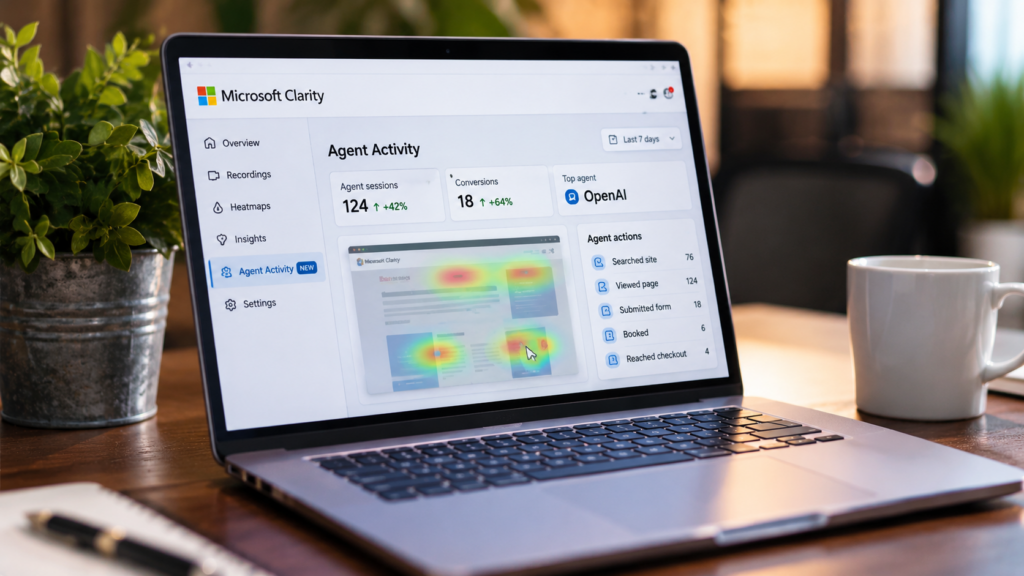
One of the most interesting additions is Agentic Analytics, which introduces a new way to understand how supported AI agents interact with websites.
Clarity has traditionally helped website owners understand human behaviour through features such as session recordings and heatmaps.
The new Agent Activity dashboard extends that visibility to certain AI-powered visitors.
For businesses, this could become an increasingly useful source of information.
After all, if an AI assistant is visiting your website on behalf of a potential customer, you’ll want to know whether it can find what it’s looking for.
What can the new dashboard show?
Microsoft’s Agent Activity dashboard is designed to provide information about supported AI agents visiting your website.
This includes agents associated with platforms such as Google, OpenAI and Anthropic.
Rather than simply identifying automated traffic, the aim is to help website owners understand how these agents interact with their websites.
Depending on the agent and available tracking information, this may include activities such as:
- Searching for products or services.
- Navigating between pages.
- Interacting with forms.
- Attempting bookings or other tasks.
- Progressing towards a checkout or enquiry.
It’s worth understanding that this doesn’t mean Clarity can identify every AI assistant visiting your website. The feature currently focuses on supported agents, and the information available will depend on how those agents operate.
Nevertheless, it represents an interesting development in website analytics.
Ask Clarity: Understanding your visitors without digging through reports
Another addition is Ask Clarity, which allows website owners to explore visitor behaviour using natural language.
Instead of manually working through analytics reports, users can ask questions about how visitors interact with their websites.
For example, you might want to understand why visitors leave a particular page or where customers encounter difficulties during an enquiry process.
The idea is to make website analytics more accessible, particularly for business owners who don’t have the time or technical experience to analyse large amounts of data.
At Bright Choice Marketing, we think this is an important direction for analytics tools.
Business owners shouldn’t need to become data analysts to understand whether their websites are working effectively.
The information should be accessible, understandable and, most importantly, useful.
AI agents could change how customers find businesses
Perhaps the most interesting aspect of this development isn’t the dashboard itself.
It’s what the dashboard tells us about the direction the internet is heading.
Traditionally, someone looking for a local service might search Google, visit several websites, compare their options and contact a business.
AI assistants are beginning to change that process.
Imagine someone asking an AI assistant to find a suitable local service provider, compare their offerings and help arrange an appointment.
Instead of the customer personally visiting every website, an AI agent may be able to carry out parts of that process on their behalf.
This technology is still developing, and it would be premature to suggest that AI agents are replacing traditional website visitors.
However, it raises an important question for businesses:
Is your website prepared for visitors who aren’t interacting with it in the traditional way?
What does this mean for small businesses?
For most small businesses, there’s no reason to rush into expensive changes or completely redesign their websites.
The fundamentals of a good website remain exactly the same.
It should be easy to navigate, provide clear information and make contacting the business straightforward.
But as AI agents become more capable, these fundamentals may become even more important.
Consider a local company offering building services.
If its website clearly explains what it does, where it operates and how customers can request a quotation, both people and automated assistants have a better chance of finding the information they need.
If the website relies on confusing navigation, poorly labelled forms or important information hidden behind complicated interactions, completing those tasks may be more difficult.
The solution isn’t necessarily to build a separate website for AI.
It’s to make your existing website clearer, more accessible and easier to use.
That’s good practice regardless of who, or what, is visiting.
Microsoft is also expanding Brand Agents
Alongside its analytics developments, Microsoft is expanding its work on Brand Agents.
These are AI-powered assistants that businesses can integrate into supported website experiences to help visitors find information and complete certain tasks.
For example, a visitor might use an assistant to identify the most suitable service, make an enquiry or arrange an appointment through a supported booking system.
For smaller businesses, this could eventually make some customer interactions more efficient.
However, these tools should complement good customer service rather than replace it entirely.
People still value being able to speak to someone who understands their needs, particularly when making important purchasing decisions.
Technology works best when it makes those conversations easier, not when it creates another barrier between a business and its customers.
What should website owners do now?
If you run a business website, we’d recommend starting with a few practical checks.
1. Review your website’s main customer journeys
Can visitors easily find your services, contact details and booking options? Test the process yourself, particularly on mobile devices.
2. Keep forms simple and accessible
Use clearly labelled fields, avoid unnecessary steps and make sure visitors receive confirmation when a form has been submitted.
3. Make your business information easy to understand
Clearly explain what you offer, where you operate and how customers can contact you. Avoid hiding important information unnecessarily.
4. Consider using Microsoft Clarity
Clarity is free and provides useful information about how visitors interact with your website.
If you’re already using it, keep an eye on the new Agent Activity features as they become available to your account.
5. Don’t forget the human experience
AI technology is advancing quickly, but your website still needs to serve the people who ultimately make decisions about your business.
A clear, reliable and accessible website benefits everyone.
Our perspective at Bright Choice Marketing
We’ve spent years designing, building and managing websites for businesses, and we’ve seen plenty of changes in how people discover information online.
The growth of AI assistants is another development worth paying attention to.
What’s particularly interesting about Microsoft’s announcement is that it begins to give website owners more visibility into a type of activity that could become increasingly relevant.
But we also believe it’s important to keep things in perspective.
Not every new technology requires an immediate investment, and not every business needs to adopt every new AI tool.
The priority should always be having a website that works properly, communicates clearly and makes it easy for customers to take the next step.
If AI agents become another way for customers to discover and interact with businesses, well-structured websites will be in a better position to adapt.
At Bright Choice Marketing, we’ll continue following these developments and exploring how they can benefit the businesses we work with.
Because ultimately, technology should make running a business easier, not more complicated.
Need help improving or managing your website?
We design, maintain and manage WordPress websites, helping businesses keep their online presence secure, reliable and ready for change.
Get in touch with Bright Choice Marketing to discuss your website.
Sources and further reading
- Search Engine Roundtable – Microsoft Clarity Gains Agentic Analytics and Ask Clarity
- ContentGrip – Microsoft Clarity Adds AI-Agent Analytics
Want a hand putting this into practice?
Tell us what you are working on and we will come back with clear, honest advice and a fair quote. No pressure, no jargon.